
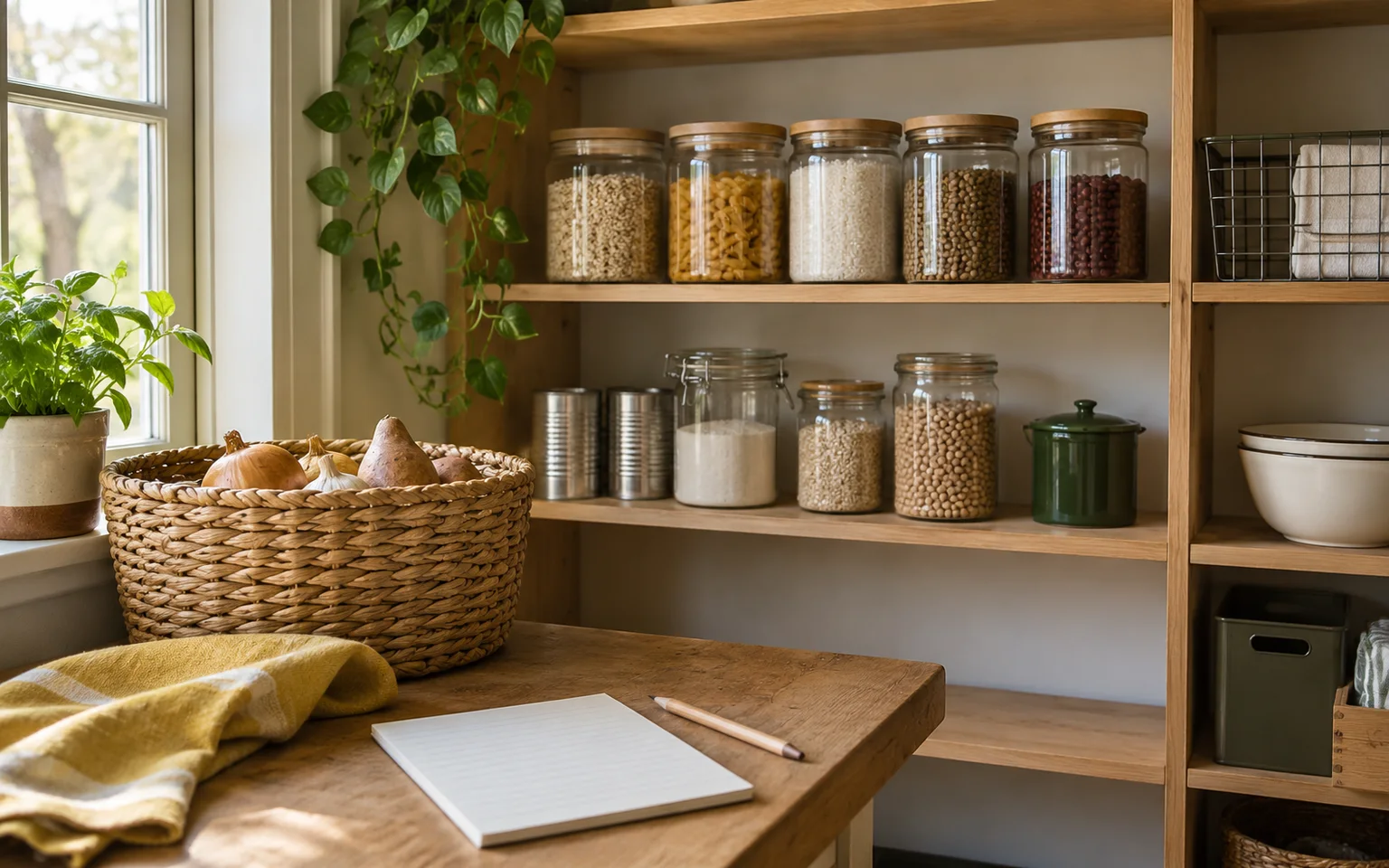
Begin with the food already in your home. A useful pantry plan does not require a large purchase, a special container system, or a target number of days. Take a small inventory of the refrigerator, freezer, cupboards, and unopened shelf-stable foods. Then organize familiar meals around the storage, water, heat, refrigeration, tools, and household needs each food requires. Add one or two foods your household already uses when normal shopping or assistance makes that possible, and use older comparable packages first.
Start with a small inventory
Choose one shelf, cupboard section, or table and work in a manageable area. List each food in plain language. Record a quantity only when it helps, along with its location, whether it is opened or unopened, any package date or lot code that matters, and a meal or snack that could use it. A note such as “unopened beans, cupboard, use with rice” is enough.
Include foods that are easy to overlook. Check the refrigerator and freezer, not just the pantry. Note foods that can be eaten without cooking, foods that need a can opener, and foods that need added water. Keep the original label with each package. The label gives storage and after-opening directions that a general pantry rule cannot replace.
As you list items, add the dependency beside the food. A dry ingredient may need potable water, a working stove or fuel, and a pan. A frozen item needs reliable cold storage. A canned food may need an opener and a bowl. A food that works during an outage without cooking may be useful in one situation and less useful if it is difficult for someone in the household to chew, open, or digest.
This first pass is not a test. It is a picture of what is available and how it can become a meal. It also shows duplicates, missing tools, and foods that need to be used soon.
Build around meals you already make
Group food by use rather than by an abstract stockpile. You might have ingredients for familiar meals, foods that can be eaten without cooking, items that depend on refrigeration, and foods that need water or heat. This is an organizing choice, not a universal list.
Write down a few ordinary combinations your household already knows. A grain with a shelf-stable protein, a soup with crackers, or a familiar breakfast may be more workable than a new product that no one wants to eat. Respect allergies, medical diets, cultural and religious foods, children, older adults, pregnancy, chewing or swallowing needs, sensory needs, and cooking ability. Include pet food and any equipment those meals require when pets are part of the household.
Storage space changes the plan. A small shelf can hold a “use next” group. A freezer can be useful while power is dependable, but frozen food needs a separate decision during an outage. If water access is uncertain, mark foods that need substantial added water. If a person cannot lift a large container, divide the task into packages that can be handled safely.
There is no universal list, quantity, budget threshold, or storage duration that fits every household. Household size, access to transportation, local availability, equipment, dietary restrictions, and assistance all change the right choice.
Add gradually without making a purchase plan the whole project
After the inventory, choose one or two foods that your household already uses and that fit the available space. Add them only as normal shopping and access allow. The next addition might be a comparable package of an ingredient already used in a meal, or a food that can be eaten with no cooking when that suits the household.
Review the inventory before shopping. This helps you avoid duplicates and notice a normal meal for foods approaching their quality date. It does not promise savings or determine what you should buy. If buying food is not workable right now, assistance can be a current path rather than a personal failure. USA.gov directs people to immediate food help from government and private organizations, including local food banks and food pantries. Availability, hours, intake rules, and eligibility vary, so confirm current details before traveling.
SNAP rules depend on the state, household circumstances, income, resources, and current federal rules. The USDA says applicants apply in the state where they live. Use the current SNAP eligibility information and the state agency to check rules and apply. Neither a food bank nor SNAP can be promised for every household, but both are dignified options to check when food access is difficult.
Put older comparable food first
First in, first out, or FIFO, is a household organization practice. Place an older comparable package where you will choose it first, then put the newer package behind it. A short “use next” note can make the choice visible. When a package is opened, mark the opening date if that helps you follow its directions.
FIFO can keep familiar foods in use and reduce waste, but it is not a food-safety rule and does not guarantee freshness. For a fuller household rotation routine, see Building a food rotation at home. Keep the original label and package information with each item. Do not transfer a date from one package to another.
Safety always overrides the rotation. Set aside food involved in a recall, food with a damaged or leaking package, food showing spoilage, food exposed to unsafe temperatures, and infant formula after its required Use-By date. Do not taste questionable food as a test. For an active outage, flood, advisory, evacuation, or other event, current local instructions and food-safety guidance take priority. Decisions about refrigerated food after a power loss belong in this food-safety guide for a refrigerator after an outage.
Read dates with the storage conditions
USDA Food Safety and Inspection Service says that, except for infant formula, food date labels generally indicate quality rather than safety and are not generally required by federal law. The wording, food, package, handling, and storage conditions still matter. “Best if Used By” or “Best if Used Before” describes expected best flavor or quality. “Sell-By” helps a store manage display time. “Use-By” generally indicates the last date recommended for peak quality, and “Freeze-By” indicates when freezing is recommended for peak quality. These are not general safety deadlines. Infant formula must not be used after its required Use-By date. See USDA's food product dating guidance for the terms and exceptions.
Do not use a date alone to clear food stored improperly, food with a damaged package, or food that conflicts with the manufacturer's directions. If food shows spoilage, discard it. Can codes are usually manufacturer tracking codes rather than consumer-readable Best-By dates. Do not use cans that are swollen, leaking, badly rusted, or deeply dented, and retain package information if a recall needs to identify the product.
Opened and unopened food are different
“Shelf-stable” describes an unopened storage condition. It does not mean the food can be stored indefinitely, kept anywhere, or left unrefrigerated after opening. Opening exposes food to air, hands, utensils, moisture, and possible contamination. Follow the package's after-opening directions or a food-specific official chart.
FDA advises prompt refrigeration or freezing for foods that require it, a refrigerator at or below 40°F (4°C), and a freezer at 0°F (-18°C). Foods that require refrigeration should generally not remain at room temperature for more than two hours, or one hour when the air temperature is above 90°F (32°C). FoodSafety.gov's cold-storage chart gives food-specific guidance, including short refrigerator times for many leftovers. Keep those limits beside the food instead of applying one pantry duration to everything.
Make the plan fit the people and equipment
Ask what each person can safely eat, open, prepare, and store. A household may need low-sodium foods, allergy-safe choices, culturally familiar ingredients, soft textures, infant supplies, or pet food. Mobility and sensory needs can affect package size, labels, lighting, and the placement of a “use next” shelf. Electricity, refrigeration, fuel, utensils, water, and a can opener can determine whether an item is actually usable.
Keep current local emergency-management, health-department, utility, and food-safety instructions ahead of an ordinary pantry routine during an active event. A reserve supports planning, but it does not guarantee that a household can stay home during every disruption.
Frequently asked questions
Should I buy a large stockpile first?
No. Begin by recording what is already at home and how it becomes a meal. A small shelf or “use next” area is enough to start, and additions can follow the household's normal access and storage limits.
Does FIFO mean an older package is safe to eat?
No. FIFO only helps you choose an older comparable package first. Recalls, spoilage, damaged packaging, temperature abuse, and infant-formula Use-By dates override the rotation.
Can I keep an opened shelf-stable food in the pantry?
Not automatically. Shelf-stable usually describes the unopened condition; after opening, follow the label's storage and time directions or a food-specific chart.
What if I cannot buy food this week?
Use current assistance options without shame. USA.gov can help you identify food banks and pantries, while USDA and your state agency provide current SNAP information; availability and eligibility vary.
What should I do during a power outage?
Follow current food-safety guidance and local instructions. Use the refrigerated-food-after-a-power-loss guidance for perishable decisions instead of relying on a normal pantry rotation.
One repeatable cycle
Once a week or at another workable interval, choose one small area. Inventory what is there, check the label and storage condition, place the older comparable package in front, and write one familiar meal that uses it. Then note the water, heat, refrigeration, tools, and household needs that meal requires. Add one fitting item only when access allows, and repeat. For a gentle starting sequence that includes other household tasks, see A calm first week.