
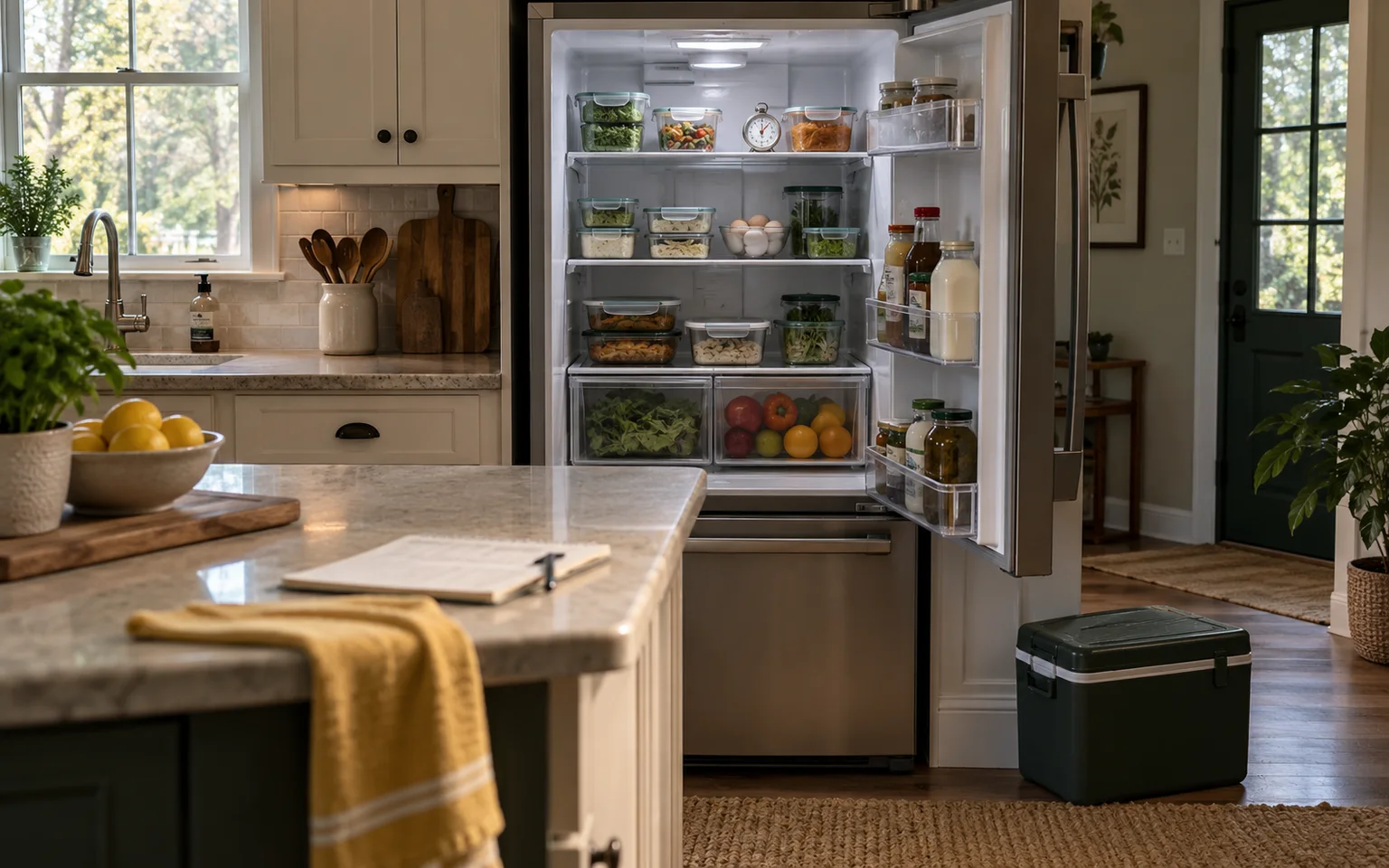
Keep both refrigerator and freezer doors closed, record when the outage began, and make separate decisions for refrigerated and frozen food. An unopened refrigerator keeps food cold for about four hours. A full freezer may hold a safe temperature for about 48 hours, or about 24 hours when half full, if the door stays closed. These are limits to guide a decision, not guarantees for every appliance. After power returns, use the time, thermometer, ice-crystal, door-opening and contamination evidence you have. When a supported boundary is exceeded or the history is unknown, discard the food. Never use a smell, appearance or taste test.
Start with the doors and the clock
Close both doors as soon as the power fails. Do not open the refrigerator to browse, and do not move items around until you have a reason and a cold source ready. Write down the outage start time, the time power returns, and each time a door is opened. A small note on the counter can prevent guesses later.
If you know the outage may last longer than four hours, prepare a cooler with ice or another cold source. The cooler helps only while the food stays at or below 40°F. Keep raw meat, poultry and seafood separate from ready-to-eat food, and keep packages sealed so their juices cannot reach other food.
An appliance thermometer gives you useful evidence. The refrigerator should be at 40°F or below, and the freezer should be at 0°F or below during normal operation. A reading after power returns can support a decision, but it cannot rebuild an unknown temperature history. If food was above 40°F for an unknown period, take the conservative action and discard it.
For a household plan that covers the record, cold sources and other power-dependent needs, use a household power-outage plan. It can sit beside your food record rather than replacing the item-by-item decision.
Refrigerator and freezer limits are different
The four-hour refrigerator estimate assumes a closed door and a reasonably cold starting point. A refrigerator-freezer compartment, a small appliance, repeated opening, warm room conditions and a warm starting temperature can shorten that time. Treat four hours as a boundary for an unopened refrigerator, not permission to keep every item until the clock reaches it.
| Unit or condition | Supported planning boundary | What changes the decision |
|---|---|---|
| Unopened refrigerator | About 4 hours cold | Door openings, appliance design, starting temperature and unknown history |
| Full freezer, unopened | Approximately 48 hours | Door opening, load, appliance design and food temperature |
| Half-full freezer, unopened | Approximately 24 hours | Door opening, load, appliance design and food temperature |
| Cooler with ice or another cold source | Keep food at or below 40°F | Measure the food, keep raw food separate and monitor the cold source |
After four hours without power or a cold source, discard refrigerated perishables such as meat, poultry, seafood, eggs, milk, cut fruits and vegetables, and leftovers. If the refrigerator or food has been above 40°F for four hours or more, discard those perishables. Food held at room temperature for two hours or more, or one hour when outdoor temperatures exceed 90°F, should also be discarded. The room-temperature rule is separate from the unopened-refrigerator estimate, so record where the food was held.
If you moved food to a cooler, the clock does not reset automatically. Keep checking the food with a thermometer. A cooler can extend storage only while the food remains at or below 40°F. When you cannot establish the time or temperature, use a safe replacement instead of trying to rescue a questionable item.
Frozen food needs temperature and ice evidence
A closed, full freezer can hold a safe temperature for approximately 48 hours. A half-full freezer can hold it for approximately 24 hours. Opening the door reduces that margin, and an appliance may perform differently from the estimate. Keep the freezer closed until you can inspect packages efficiently.
When power returns, check a freezer thermometer if one is available. Under FDA guidance, food may be refrozen or cooked when it is 40°F or below. If there is no thermometer, inspect each package for ice crystals. Food that still contains ice crystals or is 40°F or below may be refrozen or cooked. Current FoodSafety.gov item guidance can help with a partly thawed package, especially when the food or its temperature history is uncertain.
Refreezing can reduce quality even when the safety conditions support it. A watery texture after cooking or refreezing is a quality issue, not evidence that a package was safe or unsafe. The decision rests on measured temperature, ice crystals, time, food type and contamination history. Do not rely on a package that looks normal.
CDC guidance is more conservative for frozen food that has thawed. If a package has thawed and no longer has ice crystals, use the measured temperature and current item guidance. When those facts are missing, discard it. Do not put food outside in snow or use outdoor air as a safety test. Weather, animals and contamination can make outdoor storage unsafe even when the air feels cold.
Never taste it
Never taste food to decide whether it is safe. Illness-causing bacteria may not change taste, smell or appearance. An unusual odor, color or texture is a reason to discard food, but a normal-looking package is not clearance. When time or temperature evidence is missing, do not take a bite as a test.
Smell can help you notice a problem, but it cannot certify a safe item. The same is true of appearance. Reheating does not make food safe after an unsafe time-temperature exposure, and cooking is not a substitute for knowing what happened to the food.
What to keep, move, cook or discard
Start with the evidence, not the value of the food. A small amount of milk or leftovers is not worth changing a clear safety decision. If a perishable item stayed in an unopened refrigerator for less than four hours and remained at or below 40°F, keep it cold and use current item guidance. If it went into a cooler and stayed at or below 40°F, keep monitoring it. If it was above 40°F for four hours or more, discard it.
For frozen food, keep or cook a package that still has ice crystals or measures 40°F or below, following the current item chart. Refreeze it only when those conditions support refreezing. If it has thawed, the thermometer is missing, the time above 40°F is unknown, or contamination is possible, discard it.
Discard leaking, swollen, punctured or otherwise damaged containers. Food that contacted floodwater needs the applicable official instruction for that situation. Do not donate or serve food whose safety is uncertain. Bag discarded food according to local waste rules, and keep raw juices away from other food while you clean.
People and pets need a safer fallback
Anyone can get food poisoning, but adults 65 and older, children under 5, pregnant women and people with weakened immune systems have a higher risk of severe illness. If the evidence is uncertain, do not serve questionable food to them. Choose a known-safe alternative and follow a clinician’s advice when a household member has a specialized medical need.
Infant feeding has its own storage and preparation conditions. Plan for breast milk, infant formula and solid foods during an outage, keep doors closed, and use a thermometer and cold sources. A labeled safe-food backup helps when a child, an older adult, a person with allergies or a household member with a medical diet cannot easily judge food condition.
Pets also need a clear line between food that is known safe and food that is questionable. Keep pet food protected from leaking packages and contaminated water. Do not offer a pet food that you would not serve to a person because it smells unusual or has an uncertain temperature history.
Clean up after the decision
Once you have removed food that must be discarded, wash your hands and clean any shelf or surface touched by raw juices. If spoiled food leaves an odor, clean the refrigerator with a vinegar-and-water or baking-soda-and-water solution, including gaskets, shelves, sides and the door. Follow the appliance manual and never mix cleaning chemicals. Flood-contaminated food, damaged cans and chemical contamination may need separate local health or waste instructions.
Preparation can make the next decision easier. A thermometer in each appliance, frozen water or gel packs, a cooler and a simple outage record cost less space than replacing an entire refrigerator load. Rotate stored food so older items are used first. Building a food rotation at home explains how to keep dates and storage choices visible, while pantry planning with limited money can help you build a safe backup without buying everything at once.
Thermometer-and-time record
Use one row per food group or package. Record facts while they are still available.
| Record | Your note |
|---|---|
| Outage began | Date and time |
| Power returned | Date and time |
| Refrigerator door openings | Times and reason |
| Freezer door openings | Times and reason |
| Refrigerator reading | Temperature and time |
| Freezer reading | Temperature and time |
| Food location | Refrigerator, freezer or cooler |
| Food temperature | Reading and time |
| Ice crystals | Present or absent |
| Package condition | Sealed, leaking, swollen, punctured or other |
| Decision | Keep, cook, refreeze or discard |
If the record leaves a gap, mark it as unknown. Do not fill it with a smell test or a guess based on the weather. Check the current FoodSafety.gov chart or ask the local health authority for an item-specific question. The conservative boundary is simple: keep food when time, temperature and contamination evidence support it; discard when a supported limit is exceeded or the history cannot be established.
Questions households ask
Is food safe if the refrigerator still feels cold?
Feeling cold is not a measurement. Use a refrigerator thermometer or a thermometer placed in the food, and account for how long the door was open and whether the food was above 40°F.
Can I use snow to keep food cold?
Do not put perishable food outside in snow. Use a clean cooler and a cold source that keeps the food at or below 40°F, protected from animals, weather and contamination.
Can I refreeze meat that partly thawed?
Food that still contains ice crystals or is 40°F or below may be refrozen or cooked under the applicable guidance. If the temperature, time or contamination history is unknown, discard it, even if the package looks normal.
Does cooking make food safe after a long outage?
Cooking is not a remedy for food held at unsafe temperatures. If refrigerated perishables were above 40°F for four hours or more, discard them rather than trying to cook them.
What should I do with food that smells fine?
Do not use a normal smell as clearance. Bacteria that cause illness may not change smell, taste or appearance, so use the recorded time and temperature conditions instead.
Keep the thermometer-and-time record with your outage supplies. When the evidence supports keeping food, keep it cold and separate. When the record shows an exceeded limit or an unknown history, discard it without tasting.