
A workable outage plan answers three questions in order: what will your household do before the power fails, what will you prioritize while it is out, and what condition means the home plan no longer applies? Write down official alert and utility channels, safe ways to light and charge devices, food and medicine boundaries, support for people and pets, and a destination if the home becomes unsafe. Keep the record on paper as well as on a phone. Current instructions from emergency management, the utility, fire and public-health authorities, weather officials, clinicians, pharmacists, equipment suppliers, and manufacturers always take priority.
The one-page decision sequence
Before an outage, place lights, chargers, a radio, appliance thermometers, medicines, pet supplies, and your paper contact sheet where each household member can reach them. Record who checks on whom, an out-of-area contact, a meeting place, and a safe destination. Ask the utility about outage reporting and any local medical-equipment or priority-service enrollment. Programs and eligibility vary, so confirm the details for your address.
During an outage, check for immediate hazards first. Stay away from downed lines and damaged buildings. Turn to official alerts and utility updates, keep refrigerator and freezer doors closed, and check on people who depend on powered equipment, temperature control, communication access, or mobility devices. Use the plan to decide whether to remain, move to a cooling or warming location, or leave under current instructions.
The home plan ends when an evacuation or shelter instruction applies, fire or smoke threatens, carbon monoxide may be present, a structure is damaged, a person has serious heat or cold illness, a medical emergency develops, or the household cannot maintain safe conditions. Call 911 or your local emergency number for immediate danger. A website contact form is not an emergency service.
Decide how warnings and contacts will reach you
Wireless Emergency Alerts can send urgent information to a compatible phone. FEMA also identifies NOAA Weather Radio All Hazards and local opt-in text or email systems as ways to receive official warnings. Check your local emergency-management office for the systems that serve your area, then add the sign-up steps to the paper plan. Keep the utility's official outage map, phone number, text service, and account or service address with the record. Use those channels to report a loss and receive restoration information.
Write down a contact outside the affected area, two nearby people who can check the home, and a meeting place that works for children, older adults, mobility devices, and pets. Include language, hearing, vision, transportation, caregiver, and child needs only where they apply. Give more than one person permission to use the plan. If internet or cellular service is unreliable, a battery-powered or hand-crank radio can provide another way to receive weather information.
Make light, communication, and charging easy to use
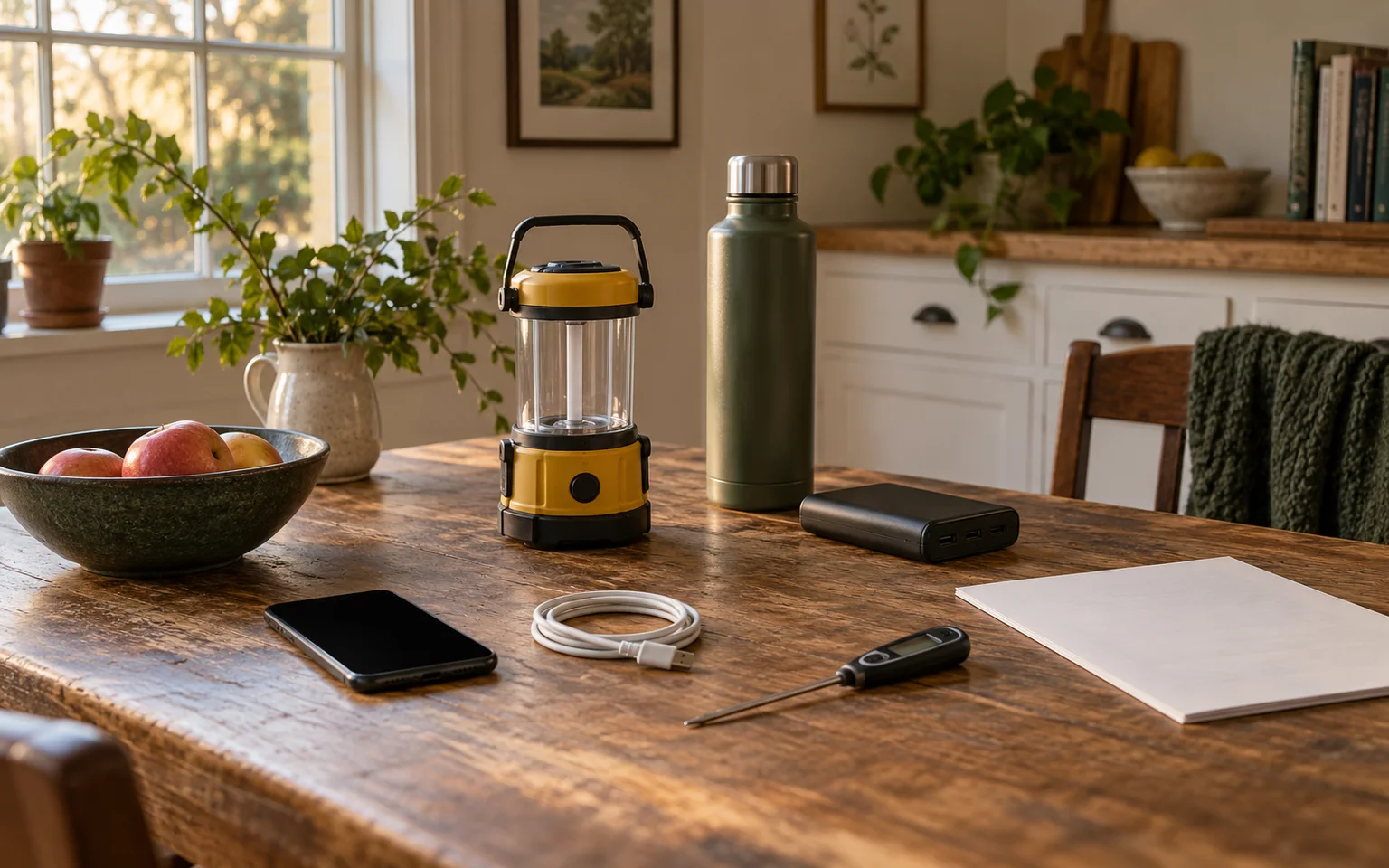
Put flashlights, headlamps, or battery lanterns in known locations, not in a box that requires searching in the dark. Keep spare common-size batteries, hearing-aid batteries, charging cables, adapters, and a car charger or power bank that fits the devices you actually use. Test compatibility and charging limits using the device and manufacturer instructions. A single battery, phone, or network is not a dependable plan by itself.
Candles and other flames add fire risk. Lower-risk electric lighting is easier to place around children, pets, bedding, and oxygen equipment. Never burn charcoal indoors. Keep any fuel or heat source away from ignition hazards and follow local fire guidance and the product instructions. For a fuller charging checklist, see charging phones when power is unavailable.
Set food decisions before you are hungry
An unopened refrigerator keeps food safely cold for up to four hours, according to USDA. A full freezer can hold a safe temperature for about 48 hours and a half-full freezer for about 24 hours when the door stays closed. A refrigerator-freezer compartment may not last as long. Keep an appliance thermometer in each appliance. USDA targets 40°F or below for the refrigerator and 0°F or below for the freezer.
Keep doors closed and note the time the power stopped. After a longer outage, an insulated cooler with enough ice can keep food at 40°F or below. Do not place perishable food outdoors in snow, and do not use smell or taste as a safety test. CDC advises discarding perishable refrigerator food after four hours without power. Frozen food may be refrozen or cooked when it still has ice crystals and feels as cold as refrigerated, but item-level decisions belong to the current USDA or FoodSafety.gov chart. Refrigerated food after a power loss can sit beside your appliance record.
Plan a few foods that do not depend on cooking or refrigeration, while respecting allergies, infant feeding, cultural needs, and the storage space you have. Rotate what you already eat instead of buying supplies you will not use. If flooding, fire, or an official order affects the kitchen, leave food decisions to the responsible authority.
Put medical and powered needs on paper
List every home-use medical device and answer specific questions before an outage: what power source does it use, how long can its backup support it according to the supplier, what alarms or batteries are needed, and whom should you call? Include oxygen or respiratory equipment, mobility-device charging, refrigerated medicines, hearing aids, communication devices, and accessibility transport when relevant. Ask the clinician, equipment supplier, utility, and emergency service about the exact device. Power-dependent household needs gives you a place to organize those questions.
Some medicines require refrigeration. CDC says that after a day or more without power, refrigerated medicine should be discarded unless its label says otherwise. If a life depends on medicine that has been at room temperature, CDC advises using it only until a new supply is available and replacing it as soon as possible. Do not change a dose or schedule from a general article. Follow the label and ask a pharmacist, prescriber, or emergency service about the exact medicine.
Treat generators, carbon monoxide, and fire as separate decisions
Never operate a portable generator inside a home, garage, basement, crawlspace, shed, porch, or carport. CPSC says to use it outdoors at least 20 feet from the home, with exhaust directed away from windows, doors, and vents. Opening a window or door does not provide enough ventilation. A working carbon-monoxide alarm with battery or battery-backup power should be on each level and outside separate sleeping areas. Never ignore an alarm.
The generator's electrical connection, weather limits, fuel storage, maintenance, and transfer equipment depend on its model and local code. Follow the current owner manual and local fire and electrical authority. Use a qualified professional for house wiring. Do not use an oven, stove, grill, charcoal, or generator as an improvised indoor heater. If you smell smoke or fuel, see flames, or hear an alarm, move away and call emergency services when safe.
Plan for heat, cold, children, and pets
An outage can remove heating, cooling, ventilation, elevators, and accessible transportation at the same time. Monitor official heat or cold products, and write down a cooling center, warming location, or trusted destination before an event. During dangerous heat, the National Weather Service advises moving to a cool or air-conditioned place, checking on people who may need help, and treating heat stroke as an emergency. In extreme cold, use layers and blankets as appropriate and watch for hypothermia. Age, health, housing, climate, and official warnings can change the decision.
Keep children close to the household plan with simple jobs such as carrying a flashlight or checking the paper contact sheet. Do not ask a child to approach a line, appliance, flame, or damaged area.
Include pets in the same decisions. Keep current identification and microchip information, food, water, medicines, records, a leash or carrier, and sanitation supplies ready. Pets can be affected by heat, cold, smoke, unfamiliar noise, and loss of water or ventilation. Arrange a trusted buddy and verify a pet-friendly destination because local shelters may not accept pets except service animals. Never leave a pet behind during an evacuation unless an authority gives a specific safe instruction. For a broader household sequence, see a calm first week.
Write a household outage record
Keep this page with your emergency supplies and give a copy to the people who may help.
- Home address, utility name, account or service address, and outage-reporting channel:
- Official alert systems, local emergency-management contact, and weather-radio location:
- Out-of-area contact, nearby check-in people, meeting place, and accessible transportation:
- Safe destination, cooling or warming option, and pet-friendly destination:
- People who need medication, refrigeration, powered equipment, communication access, or mobility charging:
- Device names, backup questions for the clinician or supplier, and the location of manuals:
- Refrigerator and freezer thermometer readings, power-loss time, and food decision chart:
- Lighting, radio, charging supplies, batteries, and fire or CO alarm check:
- Children’s needs, pet records, leash or carrier, food, water, and medicines:
- Date of the last review and the person responsible for the next check:
Review the record when someone moves in or out, a device or medicine changes, a pet’s needs change, or local contact information changes. During an active outage, follow current instructions from emergency management, the utility, fire department, public-health authority, weather service, clinician, pharmacist, equipment supplier, and manufacturer as applicable. This page cannot tell you whether to evacuate, shelter in place, approach a downed line, enter a damaged building, use a particular generator, alter medicine, or travel through a hazard.
Questions households often ask
How long can food stay safe when the power fails?
An unopened refrigerator keeps food safely cold for up to four hours, while a full freezer can hold a safe temperature for about 48 hours if its door stays closed. Check the current USDA or FoodSafety.gov chart for the specific item, and discard food when its time or temperature history is unsafe.
Can I run a generator in the garage with the door open?
No. CPSC says a portable generator belongs outdoors at least 20 feet from the home, with exhaust directed away from windows, doors, and vents. A partly open garage door is not enough protection from carbon monoxide.
What should I do if refrigerated medicine warms up?
Follow the medicine label and ask a pharmacist, prescriber, or emergency service about that exact medicine. Do not change its dose or schedule based on a general outage plan.
When should I leave the home?
Leave when an authority issues an evacuation or shelter instruction, or when fire, carbon monoxide, structural damage, dangerous heat or cold, serious illness, or another immediate hazard makes the home unsafe. Use your recorded destination and accessibility or pet arrangements, and call emergency services for immediate danger.
How can I include a pet if a shelter does not accept animals?
Arrange a trusted buddy and verify a pet-friendly destination before an outage. Keep identification, records, food, water, medicines, a leash or carrier, and sanitation supplies together, and follow current local instructions during evacuation.