

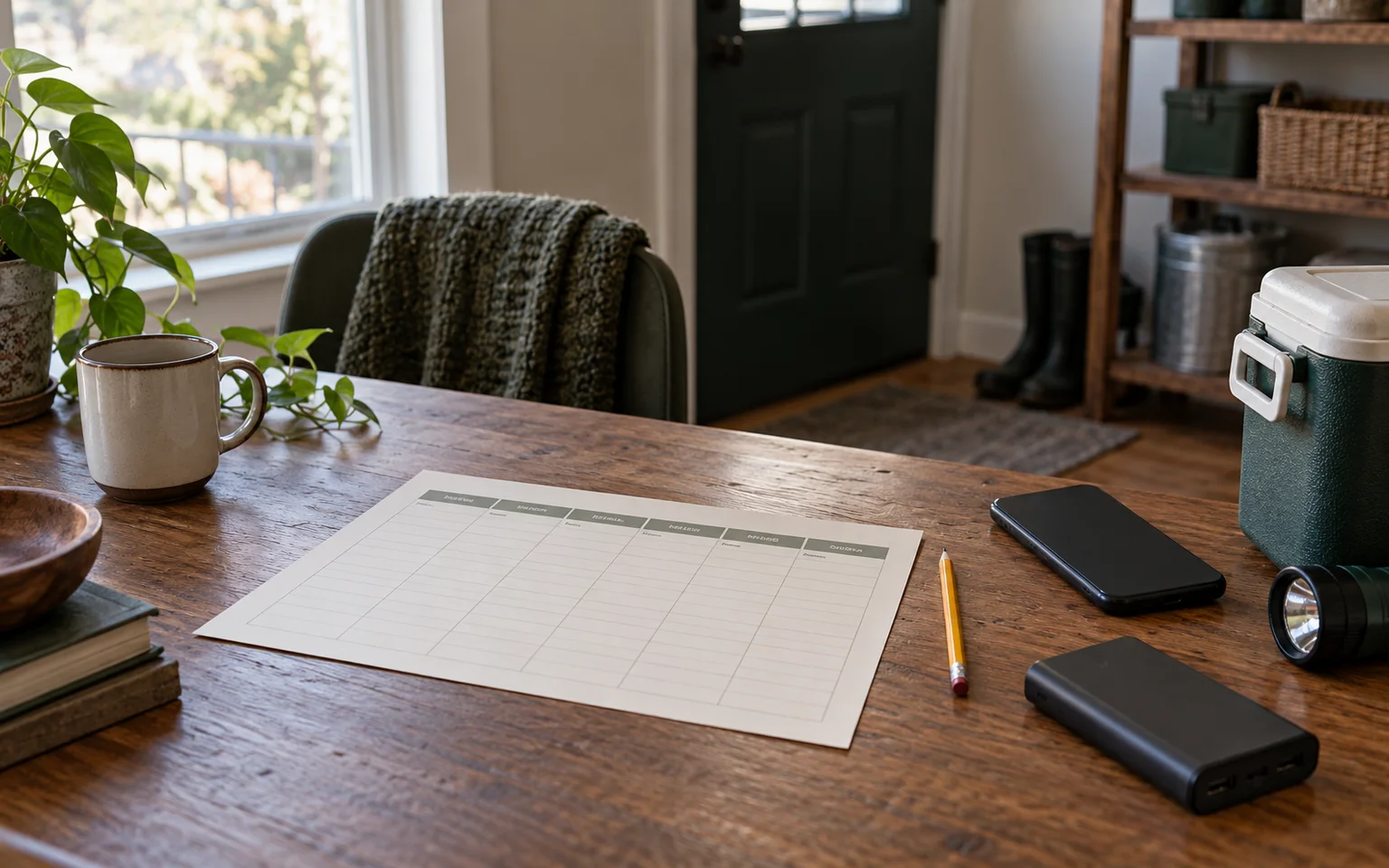
Power dependence is easiest to manage when you name it before an outage. Walk through each room and record devices, medicines, communication tools, access supports, and household systems that need electricity, charging, batteries, fuel, water pressure, internet, cellular service, or refrigeration. Mark each item as a convenience, a health need, or a safety need. Then write the exact question for its manual, clinician, pharmacist, supplier, utility, or local authority. A backup source has no universal runtime, and utility enrollment does not promise electricity or priority restoration.
Start with a room-by-room inventory
Begin with the rooms and systems you use every day. In the kitchen, list the refrigerator and freezer, appliance thermometers, electric stove or microwave, well or pressure pump, and any medicine or food that needs a labeled temperature range. In bedrooms and care spaces, list CPAP equipment, oxygen or respiratory equipment, infusion or dialysis equipment, monitors, hearing-aid chargers, mobility-device chargers, and communication aids. Include devices that charge indirectly, such as a phone that carries a medical alert or a router that connects a caregiver.
Continue through bathrooms, hallways, the garage, yard, and shared building systems. Note lighting, smoke and carbon-monoxide alarms, elevators, garage or gate controls, sump pumps, heating or cooling controls, fans, water pumps, and powered doors. A device can fail because the wall outlet is dead, its internal battery is empty, the network is down, or water pressure has stopped. Write the dependency that actually matters.
For each item, record its purpose, the person or pet who uses it, normal input, battery or fuel type, connector, alarm behavior, manual alternative, and contact person. CDC’s Power Sources checklist includes emergency lighting, common-size batteries, hearing-aid batteries, car chargers, power banks, adapters, a battery-powered or hand-crank NOAA weather radio, backup-powered smoke and CO alarms, refrigerator and freezer thermometers, and warm clothing or blankets.
Sort convenience from health and safety
Not every powered item needs the same response. A television is useful for information, but a powered wheelchair charger may affect mobility, and a respiratory device may affect treatment. A router may be optional for one household and the only way another person receives a caregiver call. Label each row with one of three plain categories: convenience, health support, or immediate safety. This lets you spend limited money and storage space on the dependency that changes the household’s choices first.
Write the consequence of a failure without guessing. For example, “no light on stairs,” “cannot open powered gate,” “caregiver cannot reach person,” or “treatment interruption requires clinician direction.” Keep the wording tied to the person’s care plan and the device manual. Do not assign a safe number of hours unless the exact supplier or manufacturer has done so for that model and use.
Ask exact questions about medical devices
If anyone uses electric medical equipment, ask before the outage rather than improvising during it. CDC advises people who use breathing machines, power wheelchairs or scooters, nebulizers, oxygen, or home dialysis equipment to make an emergency power plan, read the manual, contact the manufacturer about battery or generator compatibility, and contact the local fire department and power and water companies.
The FDA emergency preparedness worksheet supports specific questions: What happens if power is lost during treatment? Is a listed battery, inverter, generator, or manual alternative approved for this exact model? What alarms indicate low power? Which supplies must stay at a particular temperature? What should happen if treatment stops? What is the regular and after-hours emergency number?
Write the answer beside the device’s model and serial information. Keep the manual, prescription, care plan, supplier contact, clinician contact, and paper backup where a caregiver can find them. Keep spare consumables only as directed by the clinician or supplier. Do not change a treatment, dose, schedule, alarm setting, or connection because a general outage page mentions it.
Check backup power without guessing
A battery, power station, inverter, generator, or vehicle connection is suitable only when its voltage, current, connector, waveform, charging method, battery chemistry, ventilation, moisture limits, transfer equipment, and grounding requirements match the exact instructions. Ask the manufacturer, equipment supplier, and a qualified electrician the compatibility question in writing. Ask how the battery is tested and replaced, how alarms behave, where charging may safely occur, and what other devices cannot run at the same time.
There is no universal runtime or number of charges. Load, battery age, temperature, cables, conversion losses, and simultaneous devices all change performance. If a battery is swollen, leaking, cracked, unusually hot, damaged, modified, or recalled, stop using it. Follow the manufacturer, recall notice, and local household-hazardous-waste authority for handling and disposal. A damaged lithium-ion battery does not belong in ordinary trash.
Generators require a separate safety plan. CPSC says never operate a portable generator in a home, garage, basement, crawlspace, shed, porch, or carport. Place it outdoors at least 20 feet from the home, with exhaust directed away from windows, doors, and vents. Never connect it to household wiring or a medical device through an improvised arrangement. Follow the exact generator manual, local code, and qualified professional guidance where required. Keep smoke and CO alarms working, and never refuel a running generator.
Protect refrigerated medicines and supplies
List every medicine, biological product, and medical supply that has a storage requirement. Copy the labeled temperature range, not a general word such as “refrigerated.” The product label, package insert, pharmacist, prescriber, or manufacturer controls. Different products can have different limits.
If power fails, keep the refrigerator or freezer closed. FDA says that when a product must be removed, it should stay on ice or dry ice at its required temperature, and the temperature should be measured after power returns. CDC advises asking a pharmacist, prescriber, or emergency service about medicine that has been at room temperature. Do not change a dose or schedule based on a general rule.
Insulin has product-specific limits. FDA says labels generally specify refrigeration around 36°F to 46°F, while some products can remain at room temperature within their labeled range for a stated period. Heat and freezing can reduce effectiveness. Keep the product information with the medicine and ask the pharmacist or prescriber what applies to that exact product.
Keep communication and access working
Give each household member more than one way to receive warnings and instructions. Combine phone text or voice, an official local alert system, a battery radio, paper contacts, and a person who can check in. Cellular and internet service may fail or become congested, and a charged phone is not a guarantee of contact. For a practical charging record, use charging phones when power is unavailable.
Record how each person receives warnings, communicates under stress, travels, transfers or charges mobility equipment, and receives caregiver support. FEMA planning materials describe access supports such as captioning, sign-language or oral interpretation, large print, audio, Braille, plain language, notepads, accessible devices, language support, and help completing forms. Write the support needed, the person who provides it, and a second contact.
Keep service animals, mobility devices, communication aids, medication records, and identification with the person during an evacuation. Ask local emergency management about accessible transportation, shelters, cooling or warming locations, charging sites, hours, and whether medical equipment and service animals can be supported. Verify each detail with the current local authority.
Ask the utility what its program does and does not do
Some utilities and jurisdictions maintain medical-equipment, life-support, critical-needs, or special-needs registries. Others may have advance-notification lists or assistance programs. Names, eligibility, documents, renewal dates, privacy handling, and services differ by location. Enrollment does not guarantee electricity, a visit, emergency assistance, or priority restoration.
Ask the utility whether a program exists, what documents and renewal dates apply, whether enrollment affects planned-outage notice or account communication, what it does not provide, and how to report an outage. Ask local emergency management about transportation, shelters, cooling or warming sites, and charging locations. CDC guidance directs people using electric medical equipment to contact the power company and local fire department. Keep the confirmation, service address, outage number, and renewal date on paper.
Know when the home plan ends
A household power plan ends when an authority orders evacuation, the building is damaged or unsafe, there is fire, suspected carbon-monoxide exposure, a downed line, dangerous heat or cold, or a medical need cannot be supported. Call 911 or the local emergency number for immediate danger, fire, suspected CO poisoning, severe heat or cold illness, or a medical emergency. Do not approach a downed line, enter a damaged building, or wait for a website response.
FEMA recommends identifying who has evacuation authority, leaving early when mobility or medical support requires more time, arranging accessible transportation, and keeping caregivers, mobility devices, durable medical equipment, and service animals with the person. Add a destination and an alternate destination to the paper record. Water, food, pets, and additional household needs belong in the same departure decision. See water planning for pets and additional household needs for that part of the inventory.
One-page household inventory
Copy these fields to paper or a file that can be printed. Fill one row for every dependency.
- Room or system:
- Device, medicine, supply, or access support:
- Person or pet who depends on it:
- Convenience, health support, or immediate safety:
- Power, battery, fuel, water, network, or temperature dependency:
- Exact model, label, temperature range, connector, and alarm behavior:
- Approved backup or manual alternative, as confirmed by the manual or supplier:
- Exact question for clinician, pharmacist, manufacturer, or supplier:
- Utility, fire, emergency-management, caregiver, or after-hours contact:
- Paper location for the answer, prescription, manual, and records:
- Trigger that requires moving, calling for help, or stopping use:
Complete three actions. First, inventory and label every room and system. Second, ask the exact device and medicine questions and write the answers beside the model or product name. Third, verify local utility and emergency contacts, program limits, accessible transportation, and charging or cooling locations. Pair this page with a household power-outage plan when you write the wider home response. Review the page when a person, pet, device, medicine, caregiver, address, or utility account changes.
Questions households often ask
Can I assume a power bank will run a medical device?
No. A power bank is suitable only if the exact device and power source instructions approve the voltage, current, connector, charging method, and operating conditions. Ask the manufacturer or supplier before an outage and record the answer for the exact model.
Does a medical-needs registry guarantee faster restoration?
No. Programs differ by utility and jurisdiction, and enrollment does not guarantee electricity, priority restoration, a visit, or emergency assistance. Ask what the program provides, what documents and renewal dates apply, and what other local help exists.
What should I do with medicine that warmed up?
Keep it separate and follow the product label, package insert, pharmacist, prescriber, or manufacturer instructions. Do not change the dose or schedule, and ask an emergency service when the medicine supports an urgent health need.
When should a household leave because of an outage?
Leave when an authority orders evacuation, the building is unsafe, fire or suspected carbon monoxide is present, dangerous heat or cold develops, or a medical need cannot be supported. Use accessible transportation and keep caregivers, equipment, records, and service animals with the person.
Who answers an immediate safety question?
Call 911 or the local emergency number for immediate danger, fire, suspected CO poisoning, severe heat or cold illness, or a medical emergency. Contact the utility, clinician, pharmacist, supplier, fire department, or emergency-management office for the question within its responsibility.
The finished inventory does not predict an outage or promise a particular backup source. It gives your household a clear record of what depends on power, what question is still open, and who can answer it. Keep it accessible, update it when circumstances change, and follow current instructions from the responsible authority.