

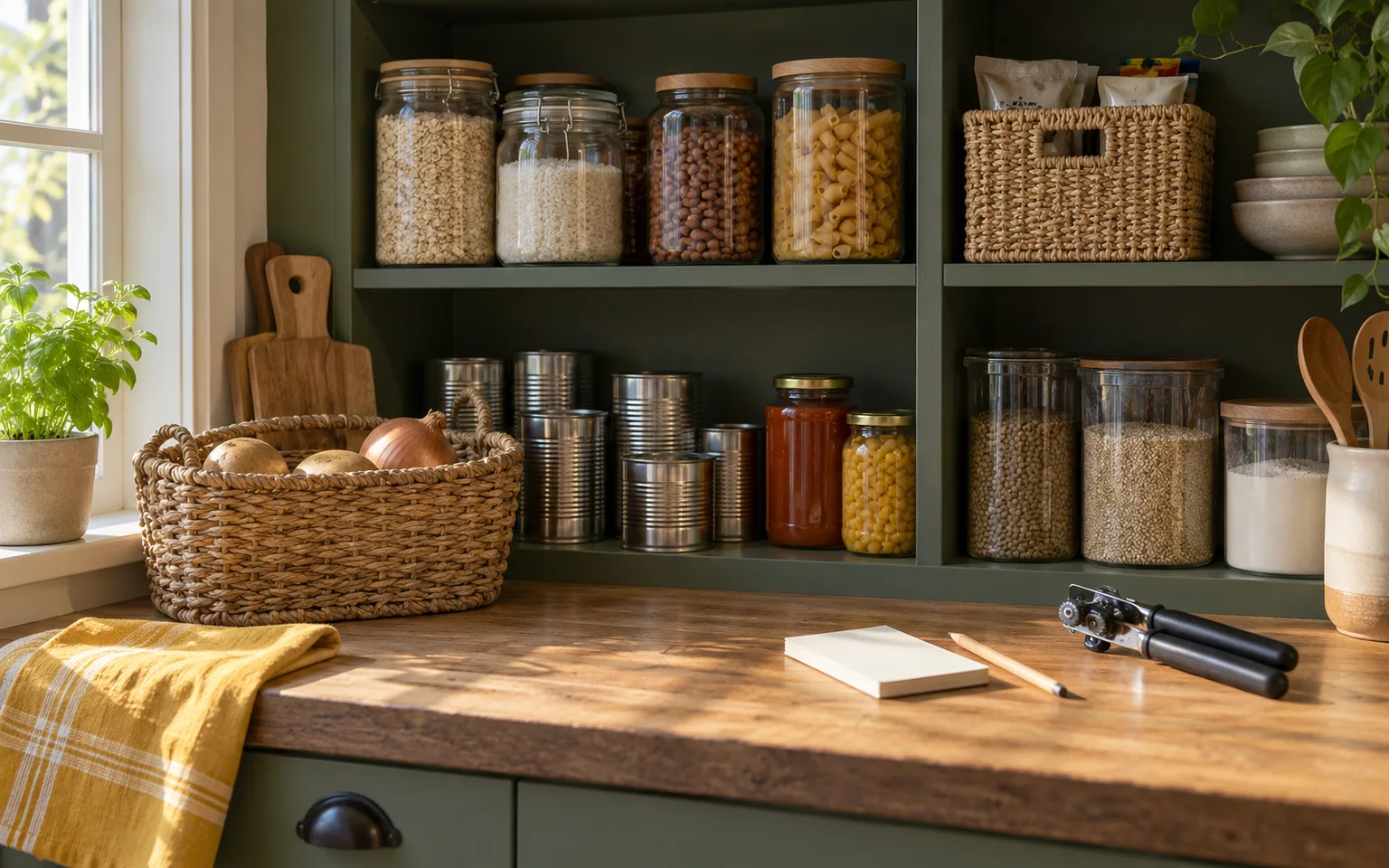
Food rotation at home can be as simple as eating the foods you already buy, placing older comparable packages where you will choose them first, and recording what needs attention. It is a meal and inventory habit, not a target number of cans or a promise that every emergency can be covered. Keep labels and package information with each item, separate opened from unopened storage, and check the food-specific directions when conditions change.
Start with meals your household already eats
Begin with one shelf, cupboard, or the foods you bought for the week. Write down the item, quantity, location, whether it is opened, any useful date or lot information, and what meal could use it next. This small record can show duplicates, missing ingredients, foods no one wants, and items that need a refrigerator, freezer, water, heat, a can opener, or another piece of equipment.
Rotation works better when it follows real meals. If your household commonly eats beans with rice, soup with crackers, or a familiar breakfast, keep those ingredients together and use the older comparable package in the next suitable meal. Include foods that fit allergies, medical diets, cultural preferences, children, older adults, people who have difficulty chewing or cooking, and pets. The right mix depends on who lives in the home and what they can safely eat and prepare.
The reserve can stay small. A purchase does not need to become a separate emergency collection. Add a newer package behind an older one, then choose the older package when it still fits the meal and its storage conditions. A small “use next” area can make this visible without reorganizing the entire kitchen.
If limited money or storage is the main constraint, start with ordinary purchases and review the list before shopping. Pantry planning with limited money explains how to make a small, budget-aware plan without assuming a particular household size or reserve level.
Read date labels as quality information
Common date phrases do not all mean the same thing. USDA Food Safety and Inspection Service explains that, except for infant formula, food date labels generally indicate quality rather than safety and are not generally required by federal law. “Best if Used By” describes expected flavor or quality. “Sell-By” helps a store manage display time. “Use-By” generally marks the last date recommended for peak quality, while infant formula must not be used after its required Use-By date. “Freeze-By” indicates when freezing is recommended for peak quality. See USDA FSIS food product dating for the terms and their limits.
A quality date passing does not automatically make a properly handled food unsafe. It also does not make food safe if it was held at an unsafe temperature, contaminated, recalled, or damaged. Food with an off odor, flavor, or texture should not be eaten, and smell or appearance cannot reliably clear every food-safety concern. The label, food type, handling, storage temperature, package condition, and manufacturer’s directions all matter.
Do not treat a printed date as a universal shelf-life table. Date wording varies by product and country, and can codes are usually manufacturer tracking codes rather than consumer-readable best-by dates. Keep the original label. Do not copy a date from one package to another. For a can, do not use it if it is swollen, leaking, badly rusted, or deeply dented. Retain package details so the product can be identified if a notice is issued.
Opened and unopened foods need different attention
“Shelf-stable” describes an unopened product stored as directed. It does not mean the food can be kept indefinitely, stored anywhere, or left unrefrigerated after opening. Opening exposes food to air, hands, utensils, moisture, and possible contamination. Follow the package’s after-opening directions, and write the opening date when that helps you apply them.
FoodSafety.gov’s Cold Food Storage Chart assumes a refrigerator at 40°F (4°C) or below and a freezer at 0°F (-18°C) or below. It lists cooked meat or poultry leftovers at 3 to 4 days in the refrigerator and 2 to 6 months in the freezer. Those figures are for the named food and conditions, not a rule for every item. Use the chart or FoodKeeper for the specific food, and follow more specific package instructions.
Opened and unopened packages can have different guidance. FoodSafety.gov gives hot dogs as one example: opened packages are listed at 1 week refrigerated and unopened packages at 2 weeks. Opened luncheon meat or deli-sliced meat is listed at 3 to 5 days, while unopened packages are listed at 2 weeks. These examples show why a single household rule is not enough. Mark opened packages, keep foods at the temperature the label requires, and do not assume an unopened pantry condition continues after opening.
Protect stored food from heat, sunlight, moisture, pests, and contamination. Avoid a location where a leak or flood could contact packages. The right temperature and duration depend on the food, container, refrigerator or freezer performance, and the product directions. There is no universal shelf-life number for every home.
Use FIFO without treating it as a safety guarantee
First in, first out, or FIFO, is a practical organizing habit. Put the older comparable package where it will be selected first, then place the newer purchase behind it. This can reduce waste and keep familiar foods in regular use. It does not override a recall, spoilage, temperature abuse, a damaged package, an expired infant-formula Use-By date, or an instruction to discard food.
Your inventory can be on paper, on a phone, or on a simple note near the pantry. A useful entry might say: canned beans, two, lower cupboard, unopened, lot code retained, use with dinner. For an opened sauce, add the opening date and its refrigeration requirement. Update the note when you use an item rather than waiting for a major cleanout.
Once a week or whenever you shop, scan the use-next area. Choose a normal meal for an item approaching its quality date, and replace it only if the household still eats it. If an item repeatedly remains unused, change the purchase rather than forcing it into the rotation. Keep ingredients and tools together when that helps, but remember that a meal may depend on water, cooking fuel, refrigeration, or a can opener.
Check recalls and package condition separately
A recall is a separate safety decision. FDA regulates foods other than meat, poultry, and processed egg products, which USDA FSIS regulates. Notices can involve pathogens, foreign material, undeclared major allergens, or other safety and labeling problems. Compare a notice with the product name, package size, UPC, lot or product code, dates, label image, and distribution information. Do not rely on the date alone. See FDA food recalls and USDA FSIS recall information for the details a notice may use.
If a food is recalled, follow that notice’s instructions. Do not eat it, give it to another person, a food bank, or a pet. Return or discard it as directed, and clean surfaces that contacted it according to the notice. Do not taste food to decide whether it is safe.
Package damage deserves attention even when the printed date looks acceptable. A swollen or leaking can, a badly rusted container, a deep dent, a broken seal, or food touched by floodwater changes the decision. Set the item aside, keep its identifiers, and follow food-safety or local authority instructions when contamination is possible.
Make the rotation fit water, equipment, and access
Food is only one part of a meal. A dry ingredient may need potable water and heat. A refrigerated item needs dependable cold storage. A household with limited cooking equipment may need foods that can be eaten as-is or prepared with what is available. People with allergies, medical diets, mobility limits, sensory needs, or limited chewing access may need different ingredients and packaging. Pets need their own suitable food and water plan.
Storage space changes the plan too. Keep heavier items where they can be moved safely, avoid blocking exits, and leave room to see package labels. If water is the limiting factor, water storage in a small home can help you think about containers, placement, and the space a meal reserve actually requires. Water stored for food preparation is part of the meal plan, not an invisible extra.
Know when an outage changes the plan
Rotation cannot make refrigerated food safe during a prolonged power loss. USDA FSIS says a refrigerator keeps food safe for up to 4 hours when the door remains closed. Keep the door shut as much as possible and use a cooler with ice or frozen gel packs if the outage will last longer. USDA advises a refrigerator at 40°F or below and a freezer at 0°F or below. A full, unopened freezer can hold temperature for approximately 48 hours and a half-full freezer approximately 24 hours, depending on conditions.
After more than 4 hours without power, USDA lists perishable foods such as meat, poultry, fish, eggs, leftovers, dairy, cut produce, and cooked vegetables among foods to discard. Never taste food to judge safety. For a more detailed decision during an outage, use refrigerated food after a power loss, and follow current local emergency, utility, health-department, or shelter instructions when they differ from a routine.
A rotation can reduce disruption by keeping some foods that do not require refrigeration and can be eaten as-is or prepared with available equipment. It cannot replace potable water, safe cooking arrangements, medication planning, pet needs, evacuation directions, or outside help.
A small routine you can repeat
Once a week, or at the interval that fits your shopping pattern:
- Look at the use-next area and choose a normal meal for one or two older comparable items.
- Check that labels, lot information, and package seals are still with the food.
- Mark opened packages when an opening date will help, and follow the product’s after-opening direction.
- Move newer comparable items behind older ones.
- Check refrigerator and freezer temperatures when you can, and review any current recall notice that could match an item you have.
- Replace only what the household uses, within its budget, space, water, and equipment limits.
Pause the routine when a recall, damaged package, suspected contamination, flood, outage, or official advisory affects the food. Use the applicable authority’s instructions. A quality date is not permission to ignore unsafe storage, and FIFO is not a clearance decision.
Frequently asked questions
Should every food have the same rotation interval?
No. Food type, package condition, temperature, handling, and whether the package is opened change the guidance. Use the label, the product directions, and a food-specific official chart rather than one calendar rule.
Is food safe after its best-by date?
“Best if Used By” generally describes quality, not safety. The food still needs proper handling and an intact package, and spoilage, a recall, temperature abuse, or a product-specific instruction can make it unsafe.
What should I do with an opened shelf-stable food?
Check the label’s after-opening directions and refrigerate it when instructed. Record the opening date when useful, because the unopened storage condition may no longer apply.
Can FIFO tell me whether a can is safe?
No. FIFO only helps organize comparable packages for use. It does not override a recall, swelling, leaking, severe rust, a deep dent, contamination, or an instruction to discard the item.
What is the first step if the power goes out?
Keep the refrigerator and freezer doors closed and track the time. If the refrigerator has been without power for more than 4 hours, use the applicable food-safety guidance and discard perishable foods listed by USDA rather than tasting them.
A workable food rotation is a modest household habit. Start with meals you already make, keep the older comparable item in front, and write down the details that affect its use. When a label, package condition, recall, outage, water limit, or household need changes the situation, let that condition control the decision.