
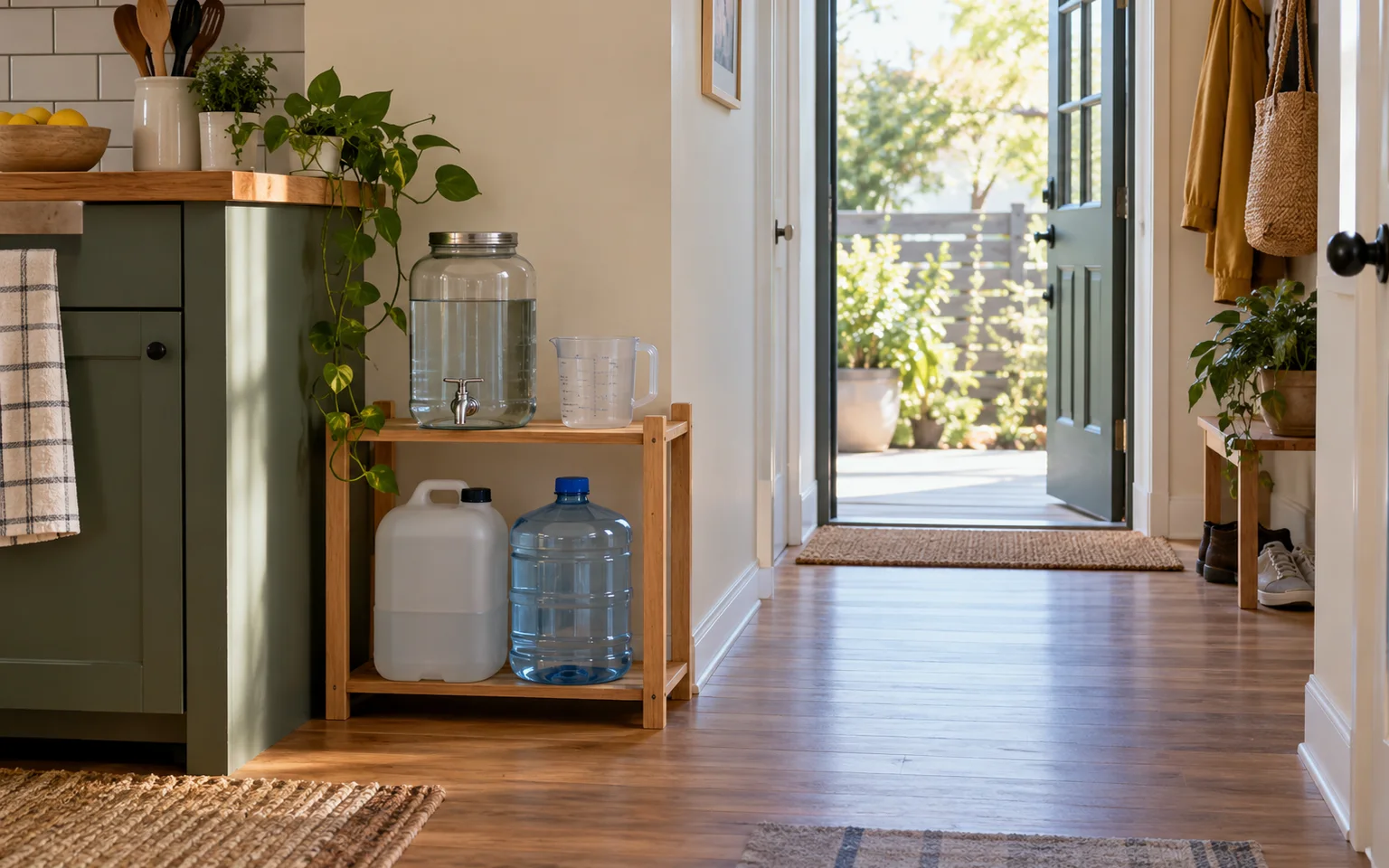
Limited space does not rule out a household water reserve. Start with the people, pets, and essential uses in your home, then choose food-grade containers that the intended users can access safely. The CDC recommends planning at least 1 U.S. gallon per person per day for three days, while recognizing that some households need more and that a two-week supply is worth working toward when possible. Treat that amount as a planning baseline, not a promise that one quantity fits every home or disruption.
Start with the space and the people
In a small home, a water plan has to work around furniture, doorways, shared rooms, and the hands that will actually open and pour the containers. A container can fit on a shelf and still be awkward to reach. A supply can meet a written target and still be hard to use if it blocks an exit, sits beside cleaning chemicals, or requires moving heavy furniture first.
Write down everyone who may depend on the supply, including pets. Add the uses that matter in your household: drinking, cooking, brushing teeth, medicines, basic hygiene, and any routine that changes how much water you need. The CDC baseline covers drinking, cooking, brushing teeth, and other uses, but it also says to consider more for pregnant people, people who are sick, pets, and hot climates. Your list gives the baseline a household meaning without inventing a universal multiplier.
If money or space is tight, you do not have to solve the entire plan on one shopping trip. A safe, labeled first reserve is a useful starting stage while you identify another approved location or set aside funds for the next container. It is not a complete supply for a specified emergency.
For broader household water decisions, see household water basics. That page can help you separate routine water use from event-specific instructions.
What the CDC baseline weighs
Three days at 1 gallon per person per day equals 3 gallons per person. USGS lists water at approximately 8.33 pounds per U.S. gallon. The water alone therefore weighs about 25 pounds for one person’s three-day baseline and about 50 pounds for two people, before the container is added.
The arithmetic becomes more useful when you compare container sizes:
| Capacity | Approximate water weight, before container weight |
|---|---|
| 1 gallon | 8.3 pounds |
| 2 gallons | 16.7 pounds |
| 5 gallons | 41.7 pounds |
| 10 gallons | 83.3 pounds |
These figures describe mass, not a safe lifting limit or a recommendation about furniture. They show why several smaller containers may be more workable than one large vessel. Smaller formats can be divided among reachable locations and used without opening the whole reserve. They also create more labels, lids, and containers to inspect.
One large container may use less floor area per gallon, but it can be difficult to move, pour, or reach when full. Several modest containers may take a little more total footprint, yet give you options if one container leaks or one person cannot handle the weight. Compare capacity, filled weight, footprint, opening, handles, cleanability, cost, replacement date, and who can access it. Follow the maker’s directions for filling, carrying, stacking, and replacement.
Do not put full containers on high shelves, unstable furniture, or in front of an exit. If a person who depends on the water cannot lift or open the selected format, choose a smaller one or arrange a supported way to access it. Never assume that a floor, shelf, balcony, or cabinet can carry a load simply because it appears convenient. For structural or lifting questions, ask a qualified professional who can assess your specific home.
Choose a suitable container
For water you fill at home, the CDC recommends FDA-approved food-grade water storage containers. Food-grade means the material is intended for contact with food or drinking water. If an approved container is unavailable, CDC says the container should close tightly, be durable, unbreakable, and preferably have a narrow opening. Never use a container that previously held toxic chemicals such as pesticides or other chemical products.
An opening affects daily use. A narrow opening may reduce contact with the water, while a wide opening may be easier to clean or refill. Neither shape solves every access problem. Look at how you will carry and pour the filled container, where it will sit, and how you will clean it without putting hands or unclean tools inside.
Keep the container maker’s instructions with your household records. The instructions may specify a fill line, cleaning method, storage position, or replacement schedule. Store the water in a cool place between 50°F and 70°F, away from direct sunlight and toxic substances, following the CDC guidance for home-filled water. In a small home, that might be a low, stable part of a closet, a protected cabinet, or another reachable spot that remains within those conditions.
Check the full path to the container. You should be able to identify it, reach it without moving heavy furniture, open it without specialized tools, and pour into a clean vessel. Keep it away from fuels, paints, cleaners, pesticides, electrical equipment, important papers, medicines, and an exit path. A tray or other leak-conscious arrangement can protect nearby belongings, but it should not make the container unstable or hard to inspect.
Fill, label, and rotate home-filled water
If you fill a container at home, wash it with soap and water first. The CDC cleaning procedure uses 1 teaspoon of unscented liquid household chlorine bleach in 1 quart, or 4 cups, of water. The bleach should contain 5% to 9% sodium hypochlorite. Cover and shake the container so the solution touches the inside, wait at least 30 seconds, pour it out, and let the container air-dry before filling it with clean water.
Keep this procedure separate from instructions for disinfecting questionable water. Bleach products differ, and this measured solution is for sanitizing the empty container. Do not substitute a generic amount or mix cleaning instructions with advice for a local water advisory.
Label home-filled water as drinking water and write the storage date on the container. CDC says to replace home-filled water every six months. Set a calendar reminder or keep a simple record with the date, container location, and any maker instructions. During each review, look for leaks, damage, a loose or dirty lid, an unreadable label, and changes in the storage conditions.
Commercially bottled water is identified by CDC as the safest and most reliable emergency source, and CDC says to observe the expiration date for store-bought water. That does not make every format equally easy to move or store. Keep the package date and directions with the supply rather than applying the six-month home-filled schedule automatically.
When dispensing, use a clean scoop or clean pouring vessel. CDC says not to touch the water or the inside of the container with your hands. If a lid, tap, or spout becomes dirty or damaged, set the container aside and follow the maker’s directions and current health guidance before using it.
Know what an advisory changes
Stored water should begin as a safe source, but an event can change what is safe to drink or use. Local authorities may recommend bottled, boiled, or disinfected water during an interruption. A boil-water advisory is not the same as a do-not-drink or do-not-use notice. Boiling or disinfection does not remove heavy metals, salts, or most other chemicals.
If flooding, fuel, chemicals, heavy metals, salts, radioactive material, a private well, or a local advisory is involved, follow the current utility, state or local health department, EPA, or CDC direction. Do not assume that boiling, a countertop filter, or a stored container resolves every contamination concern. The page on how to inspect stored water without guessing can help with routine checks and event-specific boundaries.
Verify a rental or apartment location
Renters and apartment residents often have fewer storage choices. Review your lease, building or housing policies, and applicable local safety guidance before choosing a location. If a proposed spot is near an exit, shared corridor, utility equipment, or a high shelf, choose another location or ask the responsible property or safety contact about that specific placement.
Do not assume that a balcony, closet, hallway, or floor has the same rules or conditions as another building. You can ask a clear question: Is this location approved for a sealed water container of this filled size, and are there access, egress, or equipment restrictions? Keep the answer with your household plan. If permission or conditions are unclear, use a different safe location while you continue checking.
Distributed storage can help in a small home. Several containers in approved, reachable places may be easier to access than one heavy vessel. Keep enough organization that you can inspect and date them together, and do not spread containers into unsafe or unapproved areas simply to reach a number.
Build the reserve in stages
Use a sequence that matches your household’s actual limits:
- List people, pets, essential uses, access needs, and the CDC baseline for your household.
- Choose a first container size that the intended users can safely move, open, and pour, adding the container’s own weight to the water weight.
- Select a cool, dark, protected, reachable place that does not block an exit or sit beside toxic substances.
- Fill or obtain water according to the applicable instructions, then label the source and date.
- Add another container only after checking its filled weight, footprint, access, leak risk, and the rules for the location.
- Set a review date for condition, labels, replacement dates, household needs, and current local guidance.
If funds are limited, water can be planned alongside food rather than treated as a separate purchase. Pantry planning with limited money offers a way to assign small amounts of money to household priorities while you keep this water plan realistic. For animals and other changing needs, use water planning for pets and additional household needs to identify what your baseline leaves out.
Frequently asked questions
Is 1 gallon per person per day enough for every household?
No single amount fits every person, home, or event. CDC uses 1 gallon per person per day for three days as a baseline and advises trying for two weeks when possible, with more consideration for pets, pregnancy, illness, and hot climates.
Is one large water container better than several small ones?
It depends on who must access the supply and where it can be stored. Several smaller containers can reduce the weight handled at one time, while one large container may use less footprint per gallon. Compare the filled weight, path, opening, and storage conditions before choosing.
Can I store water on a high shelf or in front of a door?
Do not place full containers on unstable furniture, high shelves, or in an exit path. Choose a low, stable, reachable location, and obtain qualified help for questions about structural capacity or lifting.
How often should home-filled water be replaced?
CDC says to replace home-filled water every six months. Label the storage date and follow any container-maker instructions. For commercially bottled water, observe the package date and storage directions.
Can boiling make any questionable water safe?
Not always. Boiling or disinfection does not destroy heavy metals, salts, or most other chemicals, and a do-not-drink notice is different from a boil-water advisory. Follow the current local utility or health department direction for the specific event.
Make one manageable start
Choose one safe, reachable location and one container format the people in your home can use. Record the filled weight, source, and date, then set a review point for six months or the maker’s stated schedule. At that review, add the next container only if its location, access, and household purpose are clear. A partial reserve is a beginning, not a claim that the household has enough for every disruption.