

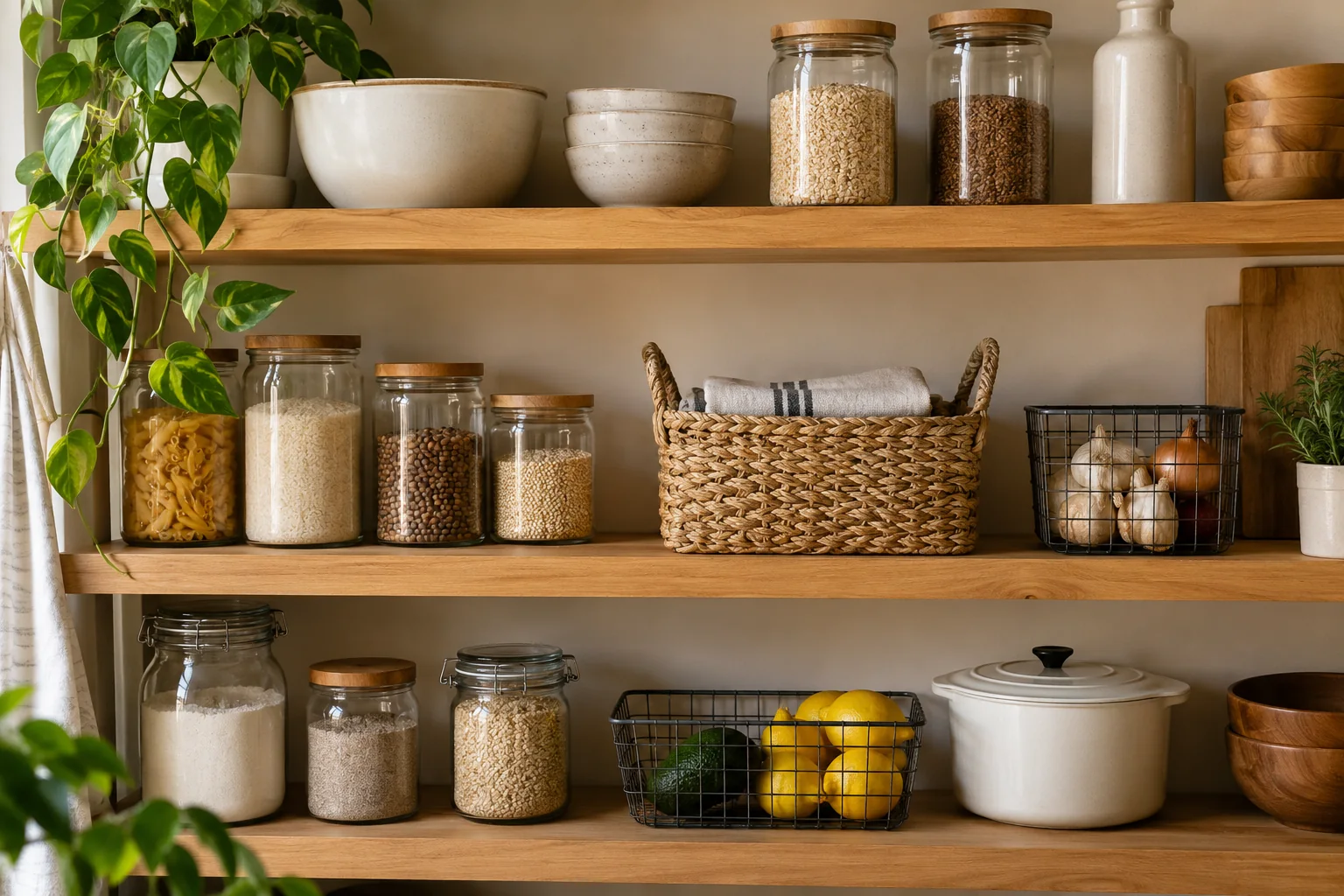
Rotate household supplies by using the oldest usable item first, placing its replacement behind it, and reading the label together with the package condition and storage history. A date can describe quality rather than safety, while damage, spoilage, heat, moisture, or a recall can change the decision sooner. Keep a short record of what you have, what the label says, where it is stored, and what you will do next. That routine lets ordinary household use support a reserve without treating every product like food.
Start with a simple first-in, first-out habit
First-in, first-out, often shortened to FIFO, means the item that entered storage first is placed where it will be used first. Put a newer replacement behind an older usable package, then return the older package to ordinary meals, cleaning, lighting, or another use that matches its label. This keeps supplies in circulation and makes the reserve easier to see.
FIFO is an organizing method, not a safety decision. Before using an older item, read its date phrase, inspect the package, and consider whether it stayed within the storage conditions on the label. If any of those facts are uncertain, pause and follow the instructions for that exact product rather than relying on its position on the shelf.
Start with one cupboard, refrigerator, freezer, or supply bin. Group similar items, put the oldest usable item at the front, and write the purchase or storage date on your record if the label does not show when it entered the home. A small space can support the same habit with a narrow shelf or one clearly marked section. You do not need a large pantry to make rotation visible.
Review the reserve when the household moves, a supply is exposed to heat or flooding, the number of people served changes, someone’s diet changes, a new medication is added, a pet joins the household, or a recall affects an item. A regular monthly household readiness check can give these records a predictable place, while the actual condition of the supply should guide an extra review between calendar dates.
Read the date beside the condition
Date wording matters, but it does not answer every question by itself. USDA explains that “Best if Used By” generally refers to peak quality rather than safety, and that federal law does not generally require quality-based date labels for food except infant formula. USDA’s food product dating guidance also recommends attention to the food’s condition and handling.
FDA describes date phrases as voluntary manufacturer wording in many cases, with “Best if Used By” pointing to quality. Food still needs proper handling and storage, and the package and contents should be free of spoilage signs. A quality date may tell you when texture, flavor, or appearance is likely to be at peak quality. It does not give permission to ignore a swollen package, an unusual odor, a leaking container, or storage outside the label’s instructions. Read FDA’s food-waste and food-safety guidance when a food decision depends on more than the printed date.
Infant formula is a separate boundary. Formula has a required “Use-By” date, and you should not buy or use it after that date. Keep that instruction beside the formula rather than applying a general pantry rule to it. If the package is damaged, the seal is compromised, or storage conditions were not maintained, use the product label and appropriate professional guidance for the next decision.
For other foods, check the package before deciding how to use them. Do not use cans that are swollen, leaking, badly rusted, or severely dented. Discard food with spoilage characteristics and follow the product’s handling instructions. When the label calls for refrigeration or freezing, a date cannot make up for time or temperatures outside those directions.
Put storage conditions in the record
Storage is part of the supply, not a detail to fill in later. Shelf-stable food may need a dry place protected from pests and moisture. Perishable food depends on the exact refrigeration or freezing directions on its label. Heat, water exposure, freezing, pests, and repeated handling can change the next action even when the date is still easy to read.
Use a record that makes the condition visible. A useful line might say: “Canned beans, four cans, Best if Used By [date], dry pantry shelf, labels readable, use the front can with the next meal.” If the item moves, update the storage note. If a package loses its label, do not guess at its identity or date from memory.
The table below is a decision aid, not a duration chart. It keeps the label, condition, storage, and next action together without creating a universal shelf life.
| Item | Label | Condition | Storage | Next action |
|---|---|---|---|---|
| Shelf-stable food | Read the exact date phrase and preparation instructions. | Look for swelling, leaks, severe dents, rust, broken seals, or spoilage signs. | Follow the label; keep it dry and protected from pests. | Use the oldest usable item in an ordinary meal, or set it aside for the product-specific decision. |
| Infant formula | Treat the required “Use-By” date as a firm boundary. | Check the seal, container, powder or liquid, and any damage. | Follow the package’s storage and preparation directions. | Do not buy or use it after the date; ask the appropriate health professional about a damaged or uncertain package. |
| Home-filled water | Record the fill date and the container instructions. | Check the closure, container, clarity, and any signs of leakage or contamination. | Follow CDC guidance and the container maker’s directions. | Replace on the applicable schedule and handle a questionable container according to current guidance. |
| Medicine | Keep the original date, name, strength, and directions visible. | Check the package, seal, appearance, and exposure to heat or moisture. | Follow the label and storage instructions. | Ask a pharmacist or clinician about stability, emergency quantities, or an exposed product. |
| Pet food or medicine | Keep the product’s date, lot information, and species or use instructions. | Check the package and contents for damage, spoilage, or an unexpected change. | Follow the exact product directions and species-specific storage needs. | Rotate before spoilage or expiration, and ask a veterinarian about a questionable item. |
Keep water on its own schedule
Water needs a separate line in your household record because the container, source, closure, and storage place all matter. For home-filled containers, CDC’s stored-water guidance advises labeling the container, replacing the water every six months, keeping it around 50°F to 70°F, and protecting it from direct sunlight and toxic substances. Follow the container manufacturer’s instructions as well. Water containers: what to compare can help you look at material, closure, capacity, and placement before you store water.
Commercially bottled water and water placed in a household container do not share every handling detail. Keep the product label with commercially bottled water, and use CDC guidance for the type of storage you are maintaining. Do not move water into an unlabeled container and assume its date or treatment history came with it. Record the container, fill date, location, and next replacement action so another person can understand the entry.
If a container leaks, has a damaged closure, sits in an unsuitable place, or comes into contact with a toxic substance, stop treating it as an ordinary rotation item. Follow current CDC and product guidance for the exact situation. Water is not a place for a guessed shelf-life rule.
Keep medicine and pet supplies out of ordinary food rules
Medicine belongs in its original labeled package whenever practical. Protect it from heat and moisture and keep the name, strength, directions, and date available to the person who may need it. A pharmacist or clinician can answer medication-specific questions about stability, emergency quantities, a changed prescription, or an item exposed to unsuitable conditions. Do not combine, repackage, extend, or alter medicine as though it were canned food.
Household need also affects a medicine record. A product that was appropriate for one person may not match another person’s prescription or condition. When a medication changes, remove the old record from the active reserve and follow the current label and the appropriate disposal or pharmacy direction.
Pet food and pet medicine need their own record. Species, product, packaging, storage, and feeding needs can differ. ASPCA advises rotating pet food and medicine before spoilage or expiration in its disaster preparedness guidance. Follow the exact label, and ask a veterinarian about a product that has been exposed, damaged, or stored outside its directions.
Use normal household life to reduce waste
The most manageable reserve is tied to things the household already eats, uses, and replaces. If a family does not normally consume an item, buying a large amount creates a rotation problem rather than solving one. Use ordinary meals to move older suitable food forward, then replace only what still fits current tastes, dietary needs, equipment, and storage space.
Building a food rotation at home can help connect routine meals to a reserve. The same principle applies to some cleaning supplies, light batteries, paper goods, and pet food, but the label and product instructions remain in charge. Do not move a product into a different use simply to avoid waste. A quality date does not make spoiled food suitable for cleaning, and an item that no longer fits one household member may not fit another.
When money is tight, replace one item when you use one rather than rebuilding every category at once. When space is tight, keep fewer kinds of supplies and make each location readable. A narrow record can prevent duplicate purchases and show which item needs attention next.
Make labels easy to find
Storage bins can group supplies, but they should not hide the information that changes a decision. Keep original labels with the item, leave room to read dates and lot numbers, and mark the outside of a bin with a broad category instead of transferring every detail to a separate note. Storage bins and the limits of organized explains how access, moisture, load limits, and labeling affect an organizing choice.
Put frequently used items where the person using them can reach and read them. Keep heavier containers low, avoid sealing a bin so tightly that inspection becomes difficult, and do not store food, medicine, water, or chemicals together when the arrangement could lead to confusion or contamination. Organization has done its job when a household member can find an item, read its instructions, and return it to the correct place.
Handle damaged items and recalls promptly
A damaged package should not stay in the rotation while you decide what to do with it later. Separate it from usable supplies, keep its label or lot information, and follow the product’s instructions or the responsible authority’s guidance. Do not taste questionable food to decide whether it is usable.
For a recall, record the product name, lot or model information, date, and where you found it. Check the responsible agency and manufacturer for the exact lot or model before use. FDA’s pet food lot-number guidance explains why keeping that information can matter for animal products. If a recall applies, follow the notice for holding, returning, or disposing of the item. Do not replace a recalled product with a similar-looking one without checking its identity.
After a heat event, flood, move, power interruption, pest problem, or change in household need, review the affected category even if no recall is announced. A clean record helps you identify what was exposed and what can remain in ordinary use. It also prevents a single uncertain package from making the entire reserve seem unusable.
Frequently asked questions
Is a “Best if Used By” date the same as an expiration date?
Usually, that phrase describes quality, such as peak taste or texture, rather than a universal safety deadline. The package condition, handling, storage, and exact product instructions still determine the next action.
Can I use infant formula after its date if the container looks fine?
No. Infant formula has a required “Use-By” date, and you should not buy or use it after that date. Keep formula decisions separate from general pantry rotation.
How often should home-filled water be replaced?
CDC guidance says to replace home-filled stored water every six months, while also following the container’s instructions and the storage conditions for that water. Keep the fill date and the next replacement action on the record.
Should medicine go in the same FIFO system as canned food?
Use a separate medicine record and keep the original label and directions visible. Ask a pharmacist or clinician about medication-specific stability, quantities, and products exposed to heat or moisture.
What should I save when a pet product may be recalled?
Keep the product name, lot number, model or other identifying information, and the place where it was stored. Check the responsible agency and manufacturer for the exact product before giving it to an animal.
Your next check
Choose one shelf or bin today. Put the oldest usable item in front, read its date phrase and condition, confirm its storage place, and write one next action. Remove damaged or spoiled items, preserve the conditions that still fit, and ask a pharmacist, clinician, veterinarian, or manufacturer about the exact medicine, pet product, water container, or package that falls outside an ordinary rotation decision.