
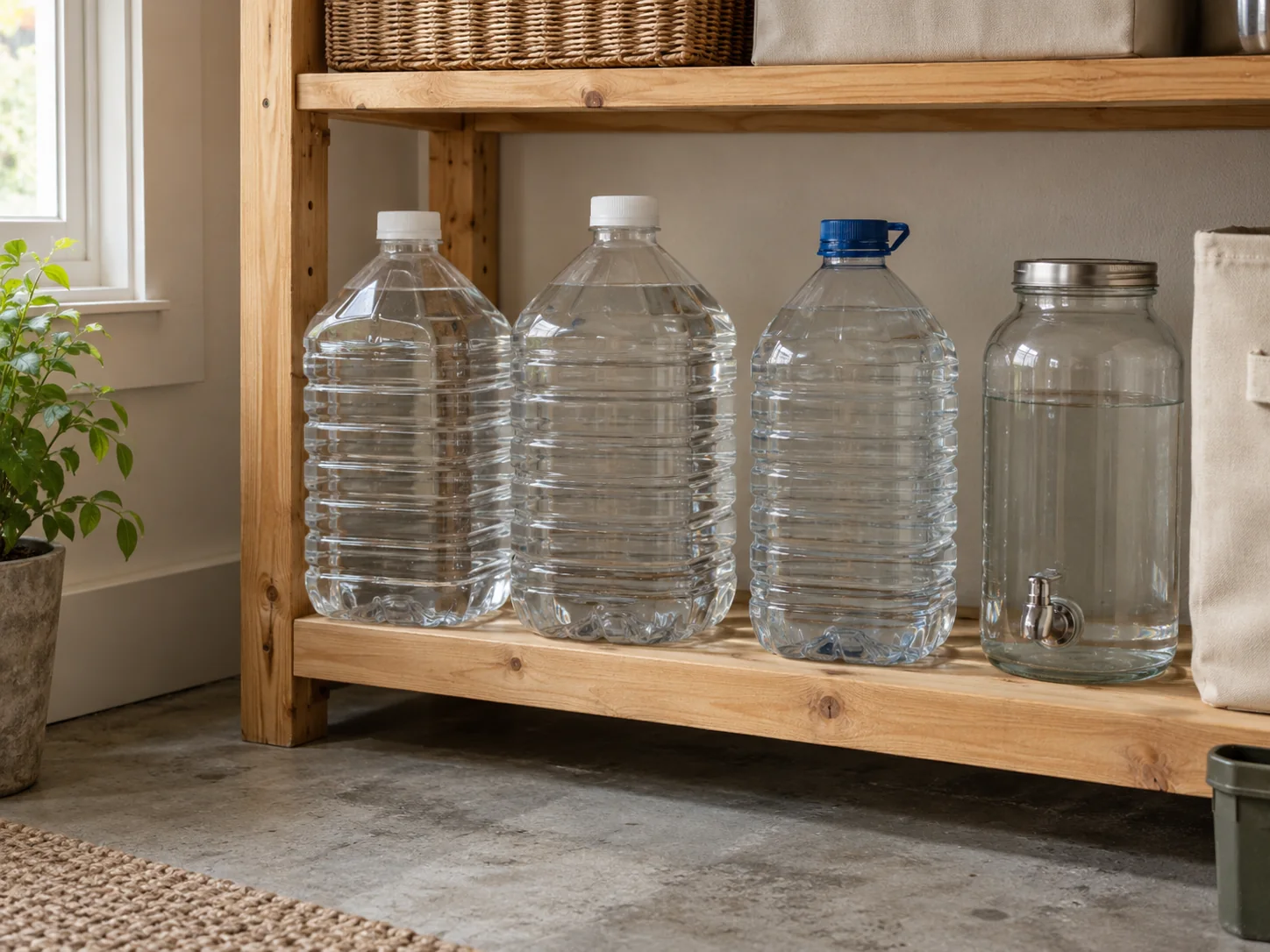
Before storing household water, compare the container’s intended use, food-contact status, exact material and label, closure, opening, capacity, handling, cleaning instructions, and storage limits. A container that works for transporting water may not fit long-term drinking-water storage, and a large container may be difficult to lift or dispense. Start with the model information, then choose a size and location that the people using it can handle safely. No container keeps water protected forever, so plan for labeling, inspection, and replacement as part of the choice.
Start with the water’s intended use
First decide what the container needs to do. Drinking and cooking water require a higher food-contact and cleanliness standard than water reserved for sanitation, washing, or another non-potable purpose. A storage bin for paper goods or cleaning supplies is not automatically a drinking-water container, even if it is sturdy and has a lid.
For water stored at home, the CDC recommends FDA-approved food-grade water-storage containers. Look for a statement that applies to the exact model, not only to a product family or a seller’s short description. If the food-contact status is unclear, ask the manufacturer whether that model is intended for the water use you have in mind.
Do not reuse a container that held toxic chemicals, including pesticides or bleach. A suitable water container should close tightly, be durable, and be unbreakable. CDC also describes a narrow opening as useful when possible, although the opening still needs to be large enough for the cleaning and dispensing method the container requires.
Read the label as a set of decisions
Terms such as “BPA-free,” “durable,” “waterproof,” or “food grade” do not answer every question. They may describe one property, but they do not tell you whether the exact container can be filled, stored, cleaned, stacked, or used with a particular temperature. Keep the label and the manufacturer’s instructions with your household record.
Before you buy or fill a container, record the exact model, material, capacity, food-contact statement, closure type, opening size, handle, spigot if present, dimensions, empty weight, stacking limits, cleaning instructions, and storage-temperature limits. If a specification matters to your household, write it down rather than relying on memory. Model numbers can help when a question comes up later.
Material affects handling and compatibility, but a material name alone is not a complete recommendation. The closure, gasket, spigot, and other parts can have their own instructions. A lid that seals tightly can reduce the chance of contamination during ordinary storage, but it does not make the water sterile, make the container safe to drop, or make it suitable for hot water.
The opening creates a practical tradeoff. A narrow opening can reduce the amount of handling at the water surface, while a wide opening may make the container easier to wash and inspect. Compare the access method with the cleaning instructions. A container that cannot be cleaned in the way its label requires is a poor fit even when its capacity looks convenient.
Compare the features that change the choice
The table below keeps the important questions together. It is a comparison aid, not a universal product rating. The exact label controls when it gives a narrower limit.
| Criterion | Question to ask before storing water | Why it matters |
|---|---|---|
| Intended use | Is this for drinking and cooking, sanitation, transport, or another purpose? | The required food-contact and cleanliness standard changes with the use. |
| Food-contact status | Does the exact model state that it is a food-grade water-storage container? | A general “food safe” phrase may not describe the model or the intended use. |
| Material and parts | What material, gasket, spigot, and other components are listed? | Each part can affect cleaning, temperature, and compatibility. |
| Closure and opening | Does it close tightly, and can you clean and access it as directed? | A tight closure helps limit contamination, while an unusable opening can undermine maintenance. |
| Capacity | How much water can it hold within the stated limit? | Capacity affects the number of containers, storage space, weight, and spill consequences. |
| Handling | Can the intended users lift, carry, pour, or dispense it safely? | A container that cannot be handled safely is not a practical choice for that household. |
| Storage | Do the location and conditions fit the temperature, light, moisture, chemical, and stacking instructions? | Water and containers can be affected by heat, direct sunlight, damage, or nearby toxic substances. |
| Maintenance | Can you label, inspect, clean, and replace the water on the needed schedule? | The container is part of an ongoing routine, not a one-time purchase. |
Match capacity to people and space
Capacity is a planning choice as well as a storage specification. CDC recommends at least 1 gallon per person per day for three days, with consideration for more water for pregnant people, people who are sick, pets, or hot climates. Treat that as a planning baseline, not a universal requirement for every household, event, climate, or duration. Household needs may also include cooking, sanitation, and access to another approved water supply.
A large container may reduce the number of items on the floor or shelf, but it concentrates weight and makes a spill more consequential. Choose a size that the people who may need the water can lift, carry, pour, or dispense without unsafe strain. A container that is manageable when full for one person may not be manageable for another person, a child, or someone whose mobility has changed.
In a small home, the usable capacity is limited by the place where the container can sit and the route to that place. Do not put a heavy container on a shelf that bows, where a leak could damage other supplies, or where it blocks a doorway or exit. Water storage in a small home addresses weight, reach, and available space together.
Consider access before you commit to a storage location. If the water is for drinking, the person who needs it should be able to identify the container and reach the dispensing method. A spigot can make pouring easier, but it adds another part to inspect and clean. A cap may be simple to carry, but opening it repeatedly can increase handling. Follow the exact product instructions for either arrangement.
Plan the fill, cleaning, and access routine
Before filling a home container, wash it with soap and rinse it. CDC’s sanitation sequence uses 1 teaspoon of unscented household chlorine bleach in 1 quart, or 4 cups, of water. Shake the solution across all inside surfaces, wait at least 30 seconds, pour it out, and air-dry the empty container before filling. Use only bleach labeled 5% to 9% sodium hypochlorite, and follow current CDC instructions.
Keep this procedure tied to the container and the water use. Do not add other cleaners, combine separate procedures, or replace the manufacturer’s instructions without checking compatibility. If the product label gives a different cleaning requirement or warns against a material or part, ask the manufacturer which direction applies to that exact model before filling it.
After filling, label the container “drinking water” and add the storage date when it holds water for drinking or cooking. Use a clean scoop or dispensing method. Avoid touching the water or the inside of the container with hands, cups, or other items that have not been cleaned for that use. Leave enough room around the label, closure, and spigot to inspect them later.
Commercially bottled water, a manufacturer-filled tank, and a home-filled container are separate categories. Their labels, treatment history, and handling directions do not automatically transfer from one category to another. Keep commercially bottled water in its original labeled packaging when practical. For home-filled water, keep the fill date and container instructions with the record.
Choose a storage place that fits the instructions
CDC says home-filled water should be kept around 50°F to 70°F, away from direct sunlight and toxic substances, and removed with a clean device that does not touch the water or the inside of the container. Place the container where the floor, shelving, moisture, light, and temperature fit both CDC guidance and the manufacturer’s instructions. When the label is more specific, follow that exact limit.
Do not store drinking water beside pesticides, bleach, fuels, or other toxic substances where a leak or spill could affect the container. Do not stack a heavy container where it could fall, injure someone, overload a shelf, or block the way out. Keep the closure visible enough to inspect and the container reachable by the people who may use it.
Water storage deserves its own location or clearly marked area. Storage bins and the limits of organized explains why a bin can help group supplies while still needing to leave labels, conditions, and access visible. A bin that hides the water container’s model, date, or closure makes later decisions harder.
Temperature and light are not the only conditions to track. Note whether the container sits near a heater, window, damp floor, chemical shelf, or busy path. A move, leak, flood, heat event, or changed household need is a reason to inspect the affected container before treating it as ordinary stored water.
Build replacement and inspection into the choice
For home-filled water, CDC recommends replacing the water every six months. Write the fill date and the next replacement date where they can be read without moving a heavy container. The date is one part of the record. Keep the model, storage place, closure condition, and any relevant handling notes with it.
Replacement does not mean the container is permanently protective between dates. Check the container and closure for damage, leaks, broken parts, or exposure to unsuitable conditions. If the water or container has been affected by a current contamination event, follow the responsible water authority and current CDC or EPA drinking-water emergency guidance. A routine date cannot override an active advisory.
The later inspection can be a short household task. Read the label, confirm the date, look at the closure and container, and verify that the storage place still fits the instructions. How to inspect stored water without guessing covers the seal, date, condition, and event history that shape that check.
Keep ordinary supply records connected to this water record. Replacing supplies without waste includes water dates, storage notes, and the difference between a normal rotation task and a condition that needs a product-specific decision. If a container is damaged or its history is unclear, set it aside and follow the exact product and public-health guidance for the situation.
Frequently asked questions
These answers clarify a few decisions that can be easy to miss when comparing containers.
Is a tight lid enough to make stored water safe?
A tight closure can reduce contamination risk during ordinary storage, but it does not make a container sterile or suitable for every use. The food-contact status, material, cleaning directions, storage conditions, and current water guidance still matter.
Can I use any sturdy plastic bin for drinking water?
No. A bin intended for organizing supplies may not have the food-contact status, closure, cleaning directions, or dispensing design needed for drinking water. Use the exact model label and manufacturer instructions, and keep water containers separate from organizing bins when their purposes differ.
How much water should one container hold?
Choose a capacity that fits the household plan and that the intended users can handle safely. CDC’s baseline of at least 1 gallon per person per day for three days helps with planning, but household needs and conditions can call for a different amount or additional water uses.
Can I fill a container that once held bleach?
Do not reuse a container that held toxic chemicals such as bleach or pesticides. Choose a container intended for food-contact water storage instead, and ask the manufacturer about the exact model when its status or history is unclear.
Does the six-month date mean the container protects water for six months?
No. For home-filled water, CDC recommends replacement every six months, while the container’s condition, storage environment, closure, and any active water advisory can require an earlier decision. Treat the date as part of a maintenance record, not a promise that the water remains suitable under every condition.
Your next check
Choose one container or one candidate model and write down its intended use, exact model, food-contact statement, material, closure, opening, capacity, handling limits, cleaning directions, storage limits, and next replacement date. Then confirm that its location is reachable, stable, away from direct sunlight and toxic substances, and compatible with the label. Choose the option that fits the household’s actual hands, space, and routine, and keep the later inspection on the calendar.